October 13 – Revelations that FIFA president Gianni Infantino has been double dipping for salary and benefits at FIFA – being paid both by FIFA in Switzerland and one of FIFA’s World Cup operating companies in the US – only puts increased pressure on the call for him to support the release of £10 million to each of FIFA’s member associations at Thursday’s FIFA Council meeting.
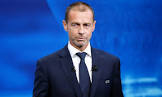
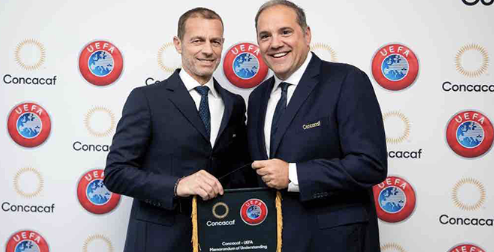
At the end of last week UEFA president Aleksander Ceferin (pictured left) and Concacaf president Victor Montagliani (pictured right) wrote to Infantino with a second recommendation that $10 million should and could be released from FIFA’s reserves without impacting the operations of the world governing body.
The letter makes a detailed case for the provision of $2.1 billion in additional FIFA funding for FIFA’s 211 member associations.
To put this proposal into context, Infantino at no point had earmarked a one-off additional payment to FIFA’s members following the $16 billion record revenues from the 2026 World Cup that will push FIFA reserves to more than $6 million.
Instead Infantino’s solution was to get more money to member associations by running a scheme to raise $4.2 billion for a 20% stake in a newly formed US business – FIFA Football Enterprise – that would own all TV rights, sponsor deals, licensing, and ticketing rights in perpetuity to FIFA competitions. It valued the whole of FIFA’s rights at $20 billion.
As an incentive (bribe?) Infantino was offering a one-off $20 million payment to member federations that agreed to the rights sell-off, but on a very short, time-limited offer, and with little detail about what the new entity entailed.
Ceferin and Montagliani’s proposal demonstrates that FIFA doesn’t have to sell off its income streams to get more money to its member associations immediately, and at the same protecting its revenues stream for football’s future generations, and establishing a “simpler and more accessible” route to enabling member associations to receive their grant entitlements. It also establishes a precedent for potentially similar financial distributions in the future.
The letter benchmarks FIFA’s reserves level with external businesses which indicate that “maintaining reserves equivalent to approximately six months of expenses can serve as a useful long term benchmark”. However they say that “a more conservative approach is appropriate. We therefore propose maintaining reserves equivalent to approximately one year of projected recurring expenditure.”
Their calculations are made on recurring expenditure rather than total cycle expenditure. “Costs associated with the men’s FIFA World Cup and men’s FIFA Club World Cup are exceptional and event specific and are largely supported by revenues generated by those competitions. We therefore do not believe they should be treated as part of FIFA’s recurring cost base.”
Ceferin and Montagliani base their numbers for the 2027-30 cycle and use FIFA’s approved 2027-30 budget as the basis of their assessment.
That budget provides for about $13.9 billion of total investments and expenses over the cycle. Once the expenditure specifically attributed to the mens’ World Cup and Club World Cup is excluded, “we propose a prudent reserve of $2.3 billion, representing one year of projected recurring expenditure”.
“Our originally proposed $10 million one-time distribution for each of FIFA’s 211 Member Associations… is conservative and more than manageable. This would be additional to the FIFA Forward funding already contemplated for the next cycle. FIFA has indicated that Forward funding for 2027-30 would increase to approximately $10 million per member association; the additional $10 million allocation would therefore represent a further 100% increase in development investment per Member Association.”
Confederations and regional associations should benefit as well
Ceferin and Montagliani also propose that the same principle of additional investment should apply to the six confederations and 13 zonal/regional associations – apparently reflecting a point made to them by Infantino.
“Given the announced 20% increase for FIFA Forward 4.0, each Confederation would receive $72 million over the four-year cycle, while each zonal/regional association would receive up to $6 million,” said the letter.
“We propose to apply a 50% increase for Confederations as a one-time additional investment, which would result in an additional $36 million per Confederation, or $216 million in aggregate.
“The same approach would provide an additional $3 million per zonal/regional association. FIFA currently recognises 13 such associations under the Forward Programme, which would represent an aggregate additional allocation of $39 million.”
With year end reserves expected to hit $6 billion, the additional disbursements proposed “would leave FIFA with ample reserves of approximately $3.6 billion, or more than 55% above our proposed prudent reserve level of approximately $2.3 billion.”
And if FIFA’s reserves top $6 billion, then “the additional amount available for distribution should be reassessed accordingly, with the objective of increasing development funding.”
Infantino, who has built a large chunk of his power base around his control of the issuance of member association grants, is now in a very embarrassing and awkward position with his supporter base.
Ceferin and Montagliani’s proposal gives them double the money, that Infantino was promising to release. Essentially the proposal illustrates that Infantino has been selling FIFA’s member associations short, and that financially he doesn’t have their best football interests in mind – never mind the ethics of using their own money to pressure them into political obedience.
There is also the question of the potentially fraudulent FFE scheme and the attempt to bribe federations with the promise of $20 million. If FIFA has so much money in reserves that it doesn’t know what to do with, why does Infantino feel the need to sell off the income streams to a third party? Why? He really needs to come clean on the reasons and needs to be much more than an apology. To put it in basic terms Infantino’s American financiers and political supporters would understand; If you try to shoot someone and then apologise, you nevertheless still tried to shoot them.
Infantino also needs to understand that accepting the proposal that everyone wants absolutely does not let him off the hook.
Turkey’s don’t vote for Christmas. But by backing the Ceferin/Montagliani proposal, FIFA’s member associations could be looking at a very happy year ending.
Contact the writer of this story at [email protected]
PakarPBN
A Private Blog Network (PBN) is a collection of websites that are controlled by a single individual or organization and used primarily to build backlinks to a “money site” in order to influence its ranking in search engines such as Google. The core idea behind a PBN is based on the importance of backlinks in Google’s ranking algorithm. Since Google views backlinks as signals of authority and trust, some website owners attempt to artificially create these signals through a controlled network of sites.
In a typical PBN setup, the owner acquires expired or aged domains that already have existing authority, backlinks, and history. These domains are rebuilt with new content and hosted separately, often using different IP addresses, hosting providers, themes, and ownership details to make them appear unrelated. Within the content published on these sites, links are strategically placed that point to the main website the owner wants to rank higher. By doing this, the owner attempts to pass link equity (also known as “link juice”) from the PBN sites to the target website.
The purpose of a PBN is to give the impression that the target website is naturally earning links from multiple independent sources. If done effectively, this can temporarily improve keyword rankings, increase organic visibility, and drive more traffic from search results.