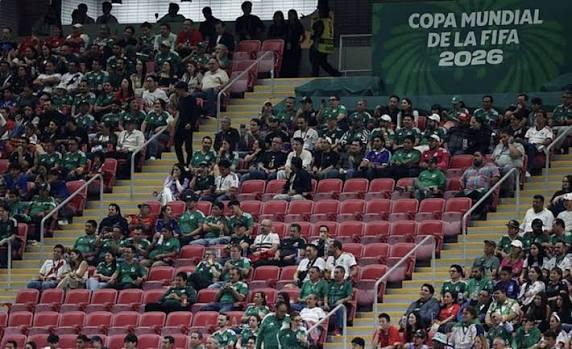
June 12 – The World Cup, digitally marred by its rocket-fuelled pricing model, had thousands of empty seats in just its second game. Who saw that coming?
Concerns over FIFA’s ticketing strategy resurfaced on Thursday after large sections of empty seats were visible during South Korea’s 2-1 victory over the Czech Republic in Guadalajara.
FIFA announced an official attendance of 44,985 for the Group A encounter at the 46,000-capacity Estadio Akron. Yet television pictures told a different story, with clear gaps throughout the stadium and thousands of seats appearing to be left cold.
Journalists in attendance similarly reported substantial empty sections, casting doubt on whether the atmosphere matched the official figures.
The FIFA announced figure is curious as it has been previously announced that for the World Cup the stadium capacity would be 44,330 (due to media and VIP seating reconfigurations for tournament matches).
The stadium optics were a sharp contrast to the tournament opener just a few hours earlier, when more than 80,000 fans packed into Mexico City’s Estadio Banorte (renamed from the Azteca) for the opening match between Mexico and South Africa.
The stadium has reduced capacity of 80,824 for the World Cup, down from 87,000.
While Mexico City was always expected to deliver a full house, Guadalajara is hardly an obscure football outpost. Widely regarded as one of Mexico’s football heartlands, the city was expected to generate a far more vibrant opening day backdrop for the tournament despite main Mexican focus being on their team in Mexico City.
There are obvious mitigating factors. South Korea and the Czech Republic are not among the competition’s biggest commercial draws, while both sets of supporters face considerable travel distances to reach Mexico. The Czech Republic also secured qualification relatively late, leaving fans with limited time to arrange what is both a lengthy and no doubt expensive trip.
Nevertheless, the images will be uncomfortable viewing for FIFA, and again highlight what has become a daily criticism surrounding ticket prices in the build-up to the tournament.
If empty seats are already becoming a talking point in Mexico – football crazed nation – there is every chance the issue intensifies once the competition moves more heavily into the United States.
High ticket prices, amongst a roster of other political issues, are a real barrier for the average supporter, while local attention is being pulled in several directions at once.
New York offers a particularly interesting case study. With the city engrossed in the NBA Finals and the prospect of a long-awaited Knicks championship, World Cup fever appears noticeably muted in the United State’s biggest city.
FIFA is banking on the scale of the event eventually cutting through, but early signs suggest that expensive tickets and divided sporting attention could prove an awkward combination for a city overall unenthused by world soccer coming to town.
For a tournament that has spent years promoting itself as the biggest World Cup ever, seeing empty seats become a storyline before the first full round of matches is complete is not part of the plan. The thing is, FIFA can’t go back and fill them up and if there are gaps in stadiums going forward, everyone is now counting them.
FIFA says it has sold more than 6 million tickets for the tournament out of 7.1 million, and demand had exceeded expectations in the ticket registration process by “a factor of 10 or more,” according to FIFA president Gianni Infantino. But expressing interest is very different to actually buying. Currently about 180,000 tickets remain unsold on official resale sites as reports abound that FIFA has been increasing their giveaway allocations to sponsors.
That the seats were unfilled is a great shame as South Korea as the Czech Republic delivered a tense and exciting match with the Koreans securing a comeback win 2-1 late in the second half.
Contact the writer of this story, Harry Ewing, at [email protected]. Additional reporting by [email protected]
PakarPBN
A Private Blog Network (PBN) is a collection of websites that are controlled by a single individual or organization and used primarily to build backlinks to a “money site” in order to influence its ranking in search engines such as Google. The core idea behind a PBN is based on the importance of backlinks in Google’s ranking algorithm. Since Google views backlinks as signals of authority and trust, some website owners attempt to artificially create these signals through a controlled network of sites.
In a typical PBN setup, the owner acquires expired or aged domains that already have existing authority, backlinks, and history. These domains are rebuilt with new content and hosted separately, often using different IP addresses, hosting providers, themes, and ownership details to make them appear unrelated. Within the content published on these sites, links are strategically placed that point to the main website the owner wants to rank higher. By doing this, the owner attempts to pass link equity (also known as “link juice”) from the PBN sites to the target website.
The purpose of a PBN is to give the impression that the target website is naturally earning links from multiple independent sources. If done effectively, this can temporarily improve keyword rankings, increase organic visibility, and drive more traffic from search results.