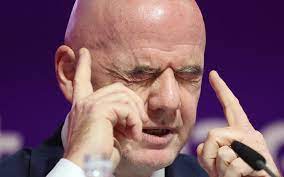
August 5 – FIFA president Gianni Infantino has underpinned his overwhelming power over the organisation with the knowledge that the African confederation (CAF) and its 54 member associations were under his absolute control.
That has been demonstrated again by his sudden summoning of senior staff for crisis meetings to Rabat, the headquarters of the Moroccan FA and its president Fouzi Lekjaa.
Why Rabat? Why not Zurich where FIFA is headquartered?
FIFA is currently under the restraint of being unable to carry out a good chunk of its daily business due to the refusal of the AFC, Concacaf and UEFA to participate in any governance decisions or meetings organised. It is effectively paralysed and will remain so until Infantino resigns.
Convening senior staff in Rabat seems like a major and unnecessary expense, even if the organisation is awash with cash. With a staff of more than 800 worldwide, surely a showing of leadership at home base would be more appropriate.
A rogues’ gallery of FIFA Council support for Infantino
Africa is where Infantino built his bedrock of support for his election to the FIFA presidency in 2016 and where subsequently he has always turned whenever major decisions have gone down to the wire.
But even for Africa, his support this time round has so far been muted. This is despite Infantino’s suspension of the FIFA Football Enterprise (FFE) plan that sparked FIFA’s current institutional crisis and wide and deep calls for his resignation.
So far only the rogues’ gallery of CAF’s FIFA Council members have issued unequivocal support for Infantino. If Infantino goes down, they will probably tumble in turn as Africa’s dissident, but silent, member associations find the courage to come out from under the yoke of FIFA’s oppression and manipulation.
Of CAF’s seven FIFA Council members, four have faced allegations that for most people would have seen them fail FIFA eligibility checks.
The CAF Council member rap sheet:
Fouzi Lekjaa (Morocco)
- Lekjaa, allegedly, head-butted Ethiopian referee Bamlak Tessema after the second leg of the CAF Confederation Cup final between RS Berkane and Zamalek that saw his team (Berkane) lose. The charges against him of assault were dismissed, despite eyewitnesses being present.
- To his credit, Lekjaa has masterminded a remarkable turnround in the fortunes of the Moroccan team, and played a very full part in winning the joint hosting rights for the 2030 World Cup with Portugal and Spain.
- (see Moroccan FA president Fouzi Lekjaa lives to fight another day at CAF)
Hany Abo Rida (Egypt)
Souleiman Waberi (Djibouti)
- In March 2024, the Djibouti Ministry of Youth and Sports suspended Waberi from all football activities over a failure to provide financial details regarding a new pitch funded by Morocco and a building funded by Saudi Arabia. He resigned as president of the Djibouti FA and in September 2024 was arrested as part of an investigation in to the embezzlement of public funds and money laundering. He kept his position as CAF’s third vice president and his FIFA Council position. He earns about $500,000 from the two roles annually.
See: CAF VP Souleiman Waberi arrested
Ahmed Yahya (Mauritania)
- Yahya and the Mauritanian FA was found to have illegally withheld €75,000 owed to ASAC Concorde for the transfers of two Mauritanian internationals to Spanish club UD Levante in January 2016. Yahya was found to have directly ordered the transfer of the money to a third party that wasn’t entitled to it.
Infantino’s noisiest supporters are those that need his support, and that of his FIFA Ethics investigators and judiciary the most.
It has engendered a fear amongst other African FAs that if they don’t do as they are instructed, they will be penalised via delays to their grant money, particularly project related grants for infrastructure which are usually co-funded with governments. Any delays for political reasons can lead to cost implications and government distrust in their FA for practical and project cashflow reasons.
There has also been the widely held misconception that European federations are lined up against African national associations and want them to fail. That isn’t the case and increasingly the African FAs are finding the opportunities to build strong allies and partners in Europe. It comes with a growing understanding that their FIFA grant money is a right and not a gift of the FIFA president.
When FIFA parachuted former general secretary Fatma Samoura in to CAF, followed later by Veron Mosengo Omba, who became CAF’s general secretary, there followed a long period that saw African football reach its lowest ebb ever as FIFA consolidated rights but lost a $100 million+ rights partner alongside disappearing broadcast and sponsorship deal for national FAs as their rights were aggregated under the FIFA sales banner only to find that FIFA could not leverage better deals.
Suddenly less national team football was being played than ever before. This was at a time when international football in the rest of the world was booming. It took eight years and two presidents before CAF returned to previous levels of competition, but even now there are doubts over the relevance of its showpiece AFCON tournament that has been shifted to a 4-year cycle from a biennial cycle and will be scheduled against UEFA’s dominating Euro Championships – a commercially life-threatening move.
Africa is always made to pay the price for FIFA and Infantino’s ambition, and at the same time expected to vote for it.
As many as 20 African nations are understood by Insideworldfootball sources to be prepared to stand against Infantino, FIFA and CAF’s demands for support. That figure will only grow as nations understand that they can put their football first, without fear of recrimination, rather than being railroaded by FIFA staff members (a FIFA Ethics violation in its own right) to support Infantino’s ambition.
Contact the writer of this story at [email protected]
PakarPBN
A Private Blog Network (PBN) is a collection of websites that are controlled by a single individual or organization and used primarily to build backlinks to a “money site” in order to influence its ranking in search engines such as Google. The core idea behind a PBN is based on the importance of backlinks in Google’s ranking algorithm. Since Google views backlinks as signals of authority and trust, some website owners attempt to artificially create these signals through a controlled network of sites.
In a typical PBN setup, the owner acquires expired or aged domains that already have existing authority, backlinks, and history. These domains are rebuilt with new content and hosted separately, often using different IP addresses, hosting providers, themes, and ownership details to make them appear unrelated. Within the content published on these sites, links are strategically placed that point to the main website the owner wants to rank higher. By doing this, the owner attempts to pass link equity (also known as “link juice”) from the PBN sites to the target website.
The purpose of a PBN is to give the impression that the target website is naturally earning links from multiple independent sources. If done effectively, this can temporarily improve keyword rankings, increase organic visibility, and drive more traffic from search results.