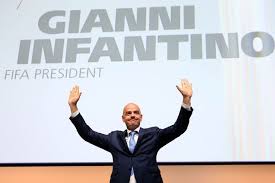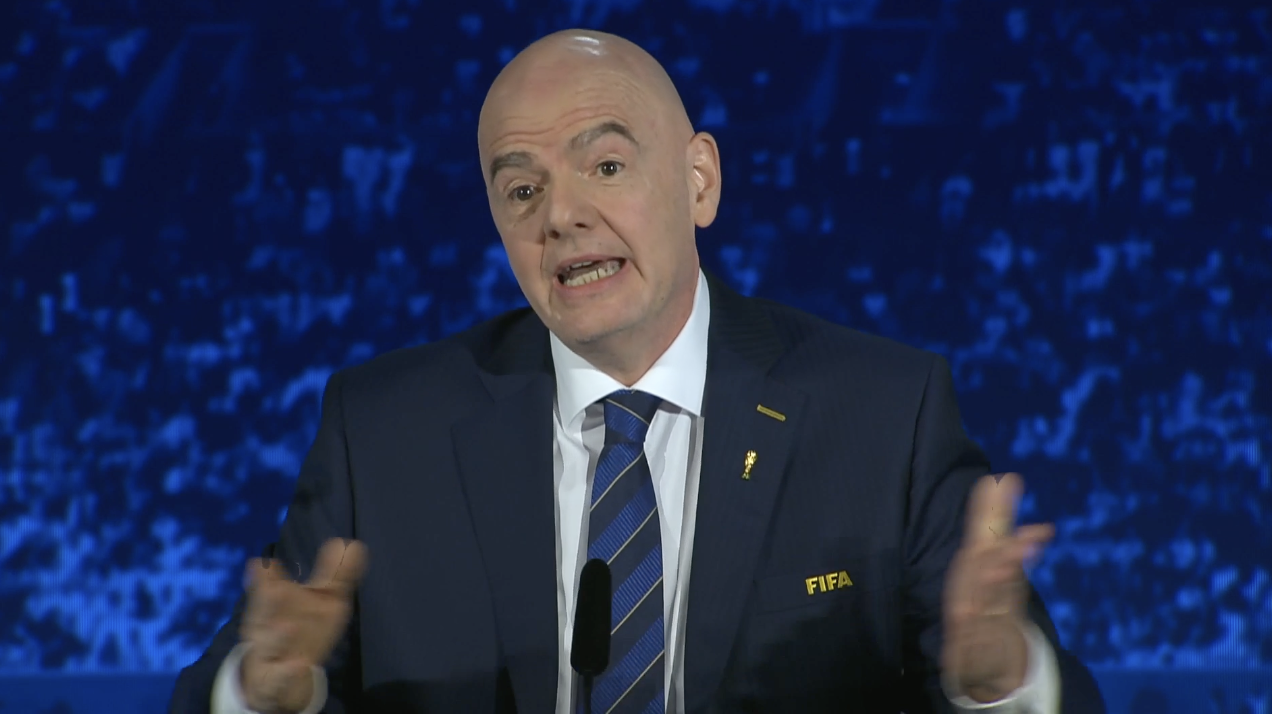
July 13 – FIFA president Gianni Infantino has said the world governing body will examine the possibility of expanding the World Cup from its new 48-team format to 64, possibly as early as 2030, which will be co-hosted by Morocco, Portugal and Spain with opening games in South America.
With Infantino up for re-election next year, the proposal would be a vote winner for any federation that is on the cusp of qualifying for the 48-team format.
Interviewed by Swiss media outlet Bluewin, Infantino said that expansion is now an issue for FIFA to deal with, having escalated it from a suggestion by Ignacio Alonso of Uruguay at a FIFA Council in April 2025, and which was picked up a month later by South America’s Conmebol president Alessandro Dominguez at the FIFA Congress in 2025.
The idea was widely dismissed by the AFC, Concacaf and UEFA as well as member associations as both a bad idea and unworkable.
A week ago Andrew Giuliani, Executive Director of the White House Task Force on the FIFA World Cup 2026 raised the possibility of a 64-team World Cup, giving the indication that it has already been discussed by the US administration and FIFA.
“When you think that this World Cup may at some point expand out to 64 teams, I think the United States can handle it,” said Giuliani. “Let me make sure we get through this World Cup on 19 July before we make our pitch for 2038 or other ones.”
At the time Giuliani’s remarks were not taken seriously by confederations or member associations, but Infantino – never one to disappoint his American hosts – said of a 64-team tournament that it is “definitely an issue that will be examined and discussed in the relevant committees after this World Cup.”
“When organising a World Cup, it’s important to organise it for the whole world – not just Europe and South America – but effectively the entire world. Every nation should be allowed to dream of participating in the World Cup,” Infantino said.
“You can see that the quality of the teams is extremely high – and it’s getting higher and higher all over the world. If you don’t give smaller countries a chance to participate in the World Cup, they’ll lack the incentive to keep improving.”
That statement is highly debateable. While there have been a few draws between minnow nations and football’s established international giants that have raised comment (usually for the bravery of their defending behind a low block), there has only been one act of giant killing in the 100 games to date. Ecuador beat Germany 2-1, though the Germans had already qualified for the first knockout round. Germany then lost to Paraguay on penalties in the round of 32.
The final four teams are the top four ranked teams in the world – Argentina, France, Spain and England. Morocco, who were the breakthrough story of the 2022 World Cup and made the semi-finals, in 2026 have sustained their status as a top nation, but were eliminated in the quarter finals.
Even so, Infantino is already saying the expanded 48-team format is a big success. Financially, it may be, though stadiums have not been sold out and FIFA was predicting $3 billion in ticket revenue. In terms of ethics and sporting integrity the tournament has been a disaster for FIFA to the point where it has lost the trust of a growing number of its member associations as well as the base of the football public at large. It is a dirty laundry list that will become a significant part of the legacy of this World Cup and Infantino’s FIFA presidency.
At the FIFA Congress in Paraguay in 2025, Dominguez exhorted FIFA’s member associations to “think in a different way”, to be “creative and think outside the box”.
“Football belongs to the world. We are transforming football. We want the world to be part of that big party that is a bigger one than the world has seen so far. The biggest party on earth. No-one can be left behind…”
“I would like to repeat – don’t change your position, but reflect together to do something that the world is waiting for, something that football deserves. That’s Conmebol’s proposal – let’s dream big.”
The problem is that bigger is not necessarily better and for the most part the 2026 World Cup has been dull and lacked standout performances and the excitement of competitive all-in football.
FIFA has damaged itself and potentially it’s Golden Egg with the 2026 World Cup. Imagine what it could do with the chaos of a 64-team tournament.
Contact the writer of this story at [email protected]
PakarPBN
A Private Blog Network (PBN) is a collection of websites that are controlled by a single individual or organization and used primarily to build backlinks to a “money site” in order to influence its ranking in search engines such as Google. The core idea behind a PBN is based on the importance of backlinks in Google’s ranking algorithm. Since Google views backlinks as signals of authority and trust, some website owners attempt to artificially create these signals through a controlled network of sites.
In a typical PBN setup, the owner acquires expired or aged domains that already have existing authority, backlinks, and history. These domains are rebuilt with new content and hosted separately, often using different IP addresses, hosting providers, themes, and ownership details to make them appear unrelated. Within the content published on these sites, links are strategically placed that point to the main website the owner wants to rank higher. By doing this, the owner attempts to pass link equity (also known as “link juice”) from the PBN sites to the target website.
The purpose of a PBN is to give the impression that the target website is naturally earning links from multiple independent sources. If done effectively, this can temporarily improve keyword rankings, increase organic visibility, and drive more traffic from search results.