October 1 – Senegal’s battle to get their 2025 Africa Cup of Nations title back goes to before the Court of Arbitration for Sport on October 8 when their appeal hearing against the Confederation of African Football (CAF) and the Royal Moroccan Football Federation (FRMF) will be heard at CAS headquarters in Lausanne, Switzerland.
The hearing will be in person and will take place behind closed doors. Representatives from the the Senegal FA (FSF) and the FRMF will be in Lausanne. CAF will be represented by their attorneys.
CAS said a final decision will not be made on the day of the hearing, so Senegal will have to wait to find out whether the three person panel – Professor Gérald Simon as President (France), Professor Luigi Fumagalli (Italy) and Professor Dr. Ulrich Haas (Germany) – agrees with their claim that they have been unfairly stripped of their title in favour of hosts Morocco.
It’s one of the stranger finals in the tournament’s history. On January 18, with Senegal and Morocco level at 0-0 deep into stoppage time, Morocco were given a penalty after a VAR check.
Infuriated Senegal coach Pape Thiaw took his players off the pitch in protest against the penalty and the chaotic scenes in the stadium Senegal’s fans rioted, throwing chairs and clashed with stewards.
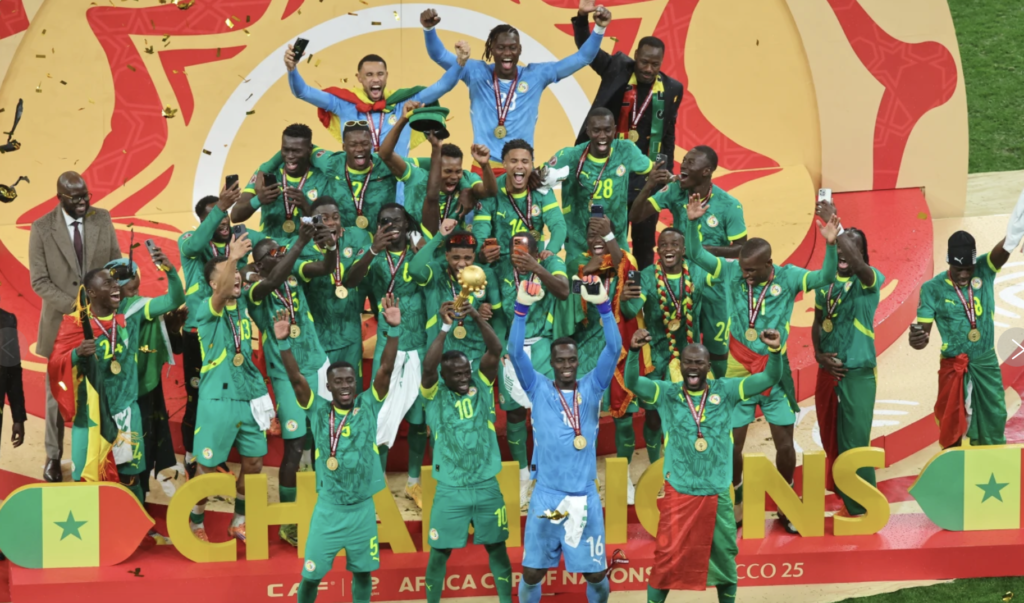
After 15 minutes the team was persuaded to return to the pitch. Morocco’s Brahim Diaz missed his spot kick before Pape Gueye won the tournament for Senegal with a 94th-minute strike. Senegal were presented with the trophy.
In early February CAF imposed sanctions totalling $715,000 in fines and handed out five match bans for manager Pape Thiaw and two players.
The Moroccan federation and national team player Ismael Saibari were fined a combined $415,000, and Saibari and a teammate received match bans. In the final, ball boys attempted to take a towel from Senegal goalkeeper Édouard Mendy, an incident that on its own resulted in a $200,000 fine for the host nation.
But that wasn’t the end of the story. On March 17, almost 60 days after the final, the CAF appeal board ruled Senegal had forfeited the final by leaving the field and awarded Morocco a 3-0 win.
CAF stated that “if, for any reason whatsoever, a team refuses to play or leaves the ground before the regular end of the match without the authorization of the referee, it shall be considered the loser and shall be eliminated for good from the current competition.”
CAF said Senegal breached Article 82 of the Africa Cup of Nations regulations, which in turn triggered the application of Article 84. Article 82 specifies that any team refusing to play or leaving the pitch before the end of regulation time without the referee’s permission will be deemed to have lost the match and will be eliminated from the competition.
However, while most Senegal players left the field and rioting erupted in the stands, not all the Senegal players left and they were rejoined by their teammates to complete the game to the final whistle.
FIFA president Gianni Infantino was present at the match and labelled Senegal’s behaviour as “unacceptable”. Moulay Rachid, brother of Morocco’s King Mohammed VI, refused to present the trophy to Senegal’s captain.
Contact the writer of this story at [email protected]
PakarPBN
A Private Blog Network (PBN) is a collection of websites that are controlled by a single individual or organization and used primarily to build backlinks to a “money site” in order to influence its ranking in search engines such as Google. The core idea behind a PBN is based on the importance of backlinks in Google’s ranking algorithm. Since Google views backlinks as signals of authority and trust, some website owners attempt to artificially create these signals through a controlled network of sites.
In a typical PBN setup, the owner acquires expired or aged domains that already have existing authority, backlinks, and history. These domains are rebuilt with new content and hosted separately, often using different IP addresses, hosting providers, themes, and ownership details to make them appear unrelated. Within the content published on these sites, links are strategically placed that point to the main website the owner wants to rank higher. By doing this, the owner attempts to pass link equity (also known as “link juice”) from the PBN sites to the target website.
The purpose of a PBN is to give the impression that the target website is naturally earning links from multiple independent sources. If done effectively, this can temporarily improve keyword rankings, increase organic visibility, and drive more traffic from search results.